
Enhance Your Eyelids with Fat Transfer and Injections
Jump To
Blepharoplasty with fat transfer combines eyelid surgery with fat grafting to address both excess skin and volume loss around the eyes. At Idaho Eyelid and Facial Plastic Surgery, oculoplastic surgeons Mark Boerner, MD, and Chad Jackson, MD, use this technique to restore youthful eye contours for patients in Boise, Eagle, Star, Meridian, Nampa, and throughout the greater Treasure Valley region, including those traveling from Eastern Oregon.
What You Should Know About Fat Repositioning in Blepharoplasty
As we age, changes around the eyes often lead to a tired or heavy appearance. The fat that normally cushions the eyeball can shift forward, creating puffiness or bulges under the eyes. At the same time, the muscles that support the eyelids, especially the orbicularis oculi, and the fat of the mid-cheek can weaken or descend. These changes contribute to droopy, baggy, or hollow-looking lower eyelids.
To address this, surgeons often use a modern technique called transconjunctival blepharoplasty, which has shown better results and fewer complications compared to older methods.
A key part of this surgery is fat repositioning — also referred to as fat transfer, fat grafting, fat transposition, or eyelid fat transposition — a technique that carefully redistributes excess fat rather than simply removing it.. Instead of simply removing fat, the surgeon carefully redistributes it, moving excess fat from areas where bulging is evident to areas that appear hollow.
This approach restores smoother, more youthful eyelid and cheek contours and avoids the sunken look that can happen with traditional fat removal alone.
By restoring volume where needed, fat repositioning helps rejuvenate the lower eyelids and midface, giving a natural and refreshed appearance without obvious scars.
Understanding the Basis of Fat Repositioning
A common concern with aging is the development of a hollow or sunken appearance under the eyes, often linked to what’s known as a tear-trough deformity (also called the nasojugal fold). This appears as a hollow groove where the eyelid meets the cheek. It can develop due to natural age-related descent of the cheek tissues or, in some cases, because of the natural shape of the cheekbone.
Alongside this hollowing, many people also notice puffiness caused by bulging fat around the lower eyelid, sometimes creating a “double contour” effect where the eyelid and cheek look uneven.
Fat repositioning directly addresses these issues. Instead of removing the bulging fat, we carefully shift it into the hollow areas, most commonly beneath the tear trough. Technically, this involves moving the medial and central fat pads into the groove, and if needed, repositioning the lateral fat pad toward the outer lower eyelid.
By redistributing fat rather than removing it, the lower eyelid contour is smoothed, the hollow groove is softened, and the eyelid–cheek transition looks more natural and youthful.
Am I a Good Candidate for Fat Transfer or Fat Repositioning?
Individuals or patients with any of the following conditions are suitable candidates for a fat transfer or fat repositioning procedure:
- Herniation of lower eyelid fat
- Individuals with tear-trough deformity
- Individuals who would accept possible risks and complications
- Individuals with realistic expectations about the outcome of surgery.
A fat repositioning procedure should be undertaken only after proper counselling regarding all possible outcomes of surgery.
Key Benefits of Blepharoplasty with Fat Transfer
- Natural, Long-Lasting Results – Using your fat cells ensures biocompatibility and creates results that look and feel completely natural. Unlike synthetic fillers, fat grafts can restore permanent volume when properly performed.
- Comprehensive Eye Rejuvenation – This technique addresses multiple aging concerns simultaneously by removing excess skin, eliminating puffiness, and restoring lost volume for complete periorbital rejuvenation.
- Improved Under-Eye Contours – Lower eyelid blepharoplasty with fat transfer effectively smooths the transition between the lower eyelid and cheek, eliminating the hollow appearance that can make eyes look tired or aged.
- Reduced Risk of Over-Correction – Fat grafting allows for precise volume control, reducing the risk of the “operated” look that can sometimes occur with traditional blepharoplasty alone.
- Enhanced Skin Quality – Fat grafts contain stem cells and growth factors that can improve skin texture and quality in the treatment area, providing additional anti-aging benefits.
How Fat Transfer or Fat Repositioning Improves Blepharoplasty Outcomes
Fat transfer or Fat Repositioning procedure, particularly the transconjunctival variety, benefits patients in one or more of the following ways:
The bony outline of the eyeball socket is covered up using the periorbital fat, which provides a thicker cover to reduce skeletonization or sunkenness and thus enhance the youthful appearance of the periorbital region.
- Modest fat removal in patients with underdeveloped orbital rims can reduce eye prominence by adding coverage over the bony rim and lifting sunken areas.
- Orbital fat can be shifted below the levator labii superioris alaeque nasi to soften a deep nasojugal groove.
- Traditional blepharoplasty may expose the orbital rim, creating a sunken-eye look, while fat repositioning helps restore natural fullness and improve overall eye appearance.
What Are the Possible Advantages and Disadvantages of Fat Repositioning?
Fat repositioning is advantageous in preventing the development of tear-trough deformity. It is more often used to treat herniated orbital fat with minimal risk of complications.
However, fat repositioning has its disadvantages in being difficult to master, with a steep learning curve. Poor fat repositioning by an inexperienced surgeon is associated with complications such as double vision due to inadvertent inferior oblique muscle injury, development of fat granulomas, prolonged oedema or swelling, and occasionally, permanent irregularities of soft tissues.
Summary of Fat Transfer or Fat Repositioning Procedure
- Transcutaneous lower blepharoplasty has been replaced by transconjunctival blepharoplasty, which surpasses the former in terms of patient satisfaction and fewer complications. This change has heralded fat transfer or fat repositioning as an integral procedure with transconjunctival lower blepharoplasty.
- However, the use of transconjunctival blepharoplasty is limited by the significant learning curve associated with this technique.
- Fat transfer or fat repositioning has thus become a rising star in eyelid surgery.
What to Expect During Recovery and Healing
Initial swelling and bruising peak within 48-72 hours and gradually subside over the first week. Most patients return to light activities within a few days. Sutures are removed within one week, and patients typically resume normal activities during weeks one through two.
The actual results of eyelid contouring surgery become apparent during weeks two through six. Some fat reabsorption is normal during this period. Complete healing and final results are visible within 3-6 months, with surviving fat grafts providing permanent volume enhancement.
Cost of Fat Transfer Eyelid Surgery in Boise, ID
Procedure costs vary based on the extent of surgery needed, the amount of fat grafting required, and facility fees. During your consultation at Idaho Eyelid and Facial Plastic Surgery, we provide detailed pricing for your eye rejuvenation surgery.
See the Results of Fat Transfer Eyelid Surgery
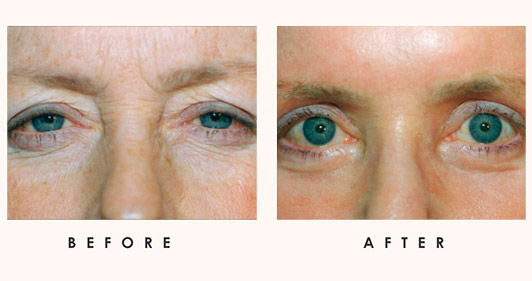
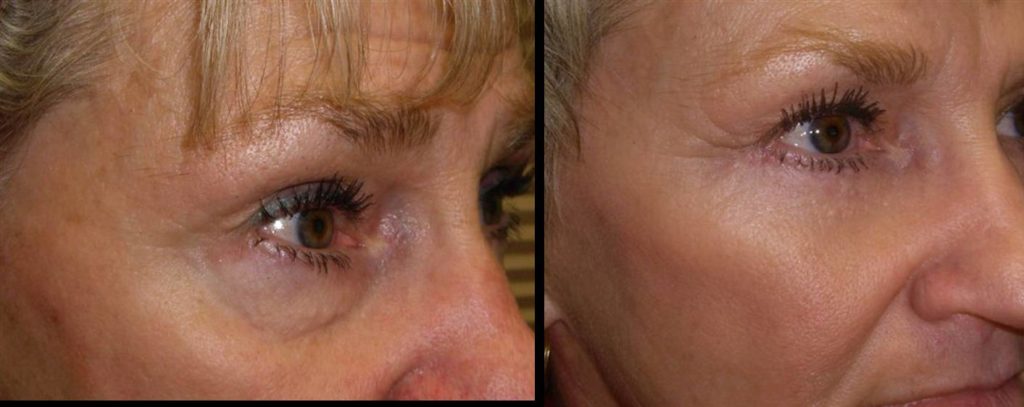
Our gallery demonstrates how under-eye fat transfer restores youthful eye contours. Explore before-and-after photos of our patients who underwent eyelid fat transfer and their outcomes.
Why Choose Idaho Eyelid and Facial Plastic Surgery
Dr. Mark Boerner and Dr. Chad Jackson are board-certified oculoplastic surgeons serving Boise, Eagle, Star, Meridian, Nampa, and the broader Treasure Valley, as well as patients from Eastern Oregon, specializing exclusively in eyelid and facial procedures. As dedicated eyelid experts, they have extensive experience in periorbital fat grafting and advanced blepharoplasty techniques.
Our practice focuses on natural eyelid rejuvenation using the latest surgical methods. We provide personalized treatment plans based on your unique anatomy and aesthetic goals. Our surgeons’ specialized training in oculoplastic surgery offers optimal safety and results for delicate eye area procedures.
Blepharoplasty with Fat Transfer: Common Questions Answered
Schedule Your Personalized Eyelid Consultation
Take the next step toward a more youthful appearance. Contact our Boise practice today at (208) 344-3220 to schedule your consultation — conveniently serving patients in Eagle, Star, Meridian, Nampa, Treasure Valley, and Eastern Oregon. Our highly skilled oculoplastic surgeons at Idaho Eyelid and Facial Plastic Surgery are ready to evaluate your unique needs and create a customized blepharoplasty with fat transfer plan.